Guide
Realism and Microrealism
11 ottobre 2026
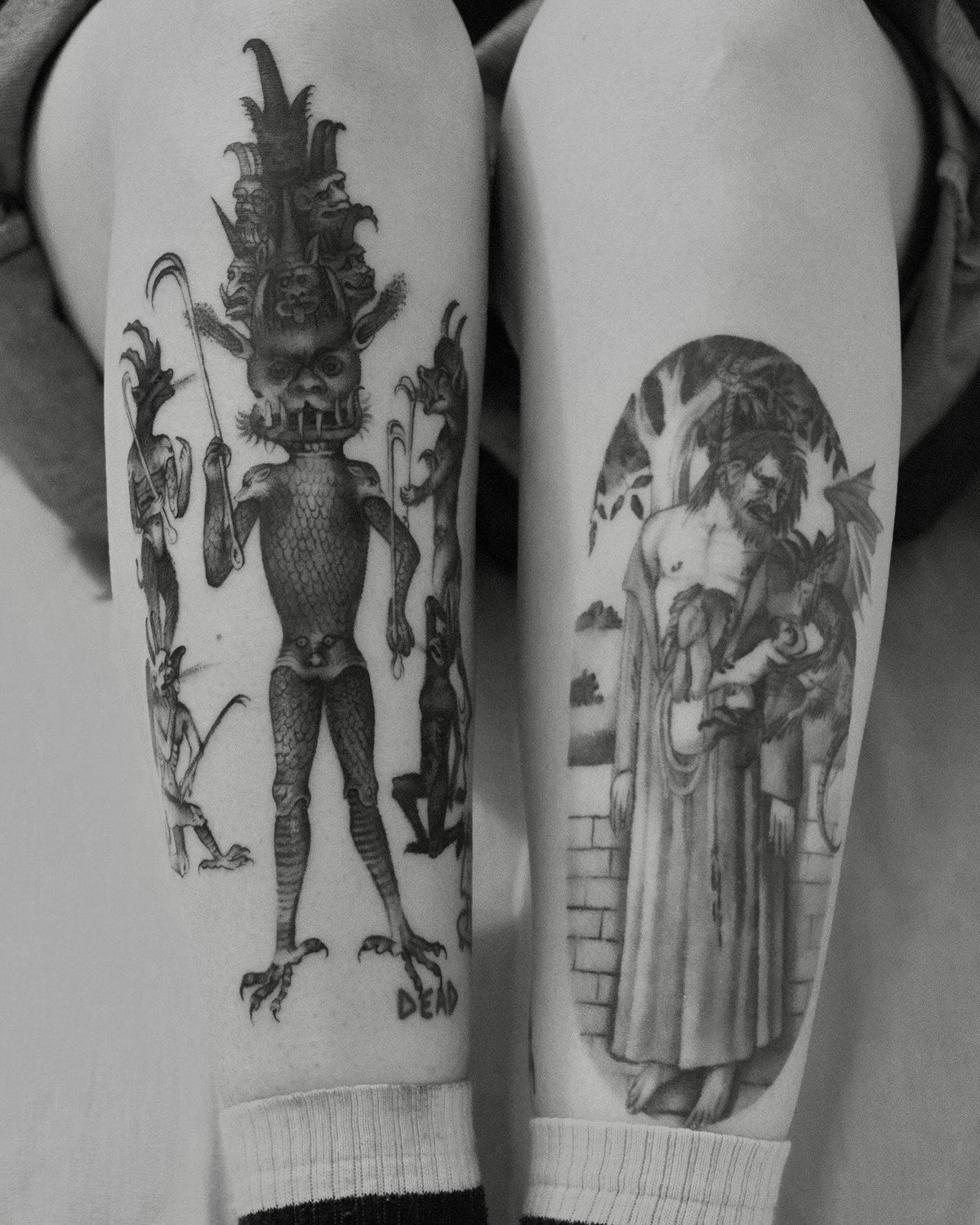
Realism in tattooing means work that tries to look like the thing itself: a face, a hand, a sculpture, a building, rendered with light and shadow rather than outline. Most Realism today is done in Black and Grey, built from black ink diluted into graded tones. Microrealism applies the same approach at small scale, often a few centimetres across, where every tone has less room to sit in.
It is the style where technique is most visible. A line-based tattoo can be simple and still be good. A realistic piece either holds together or it does not, and you see the difference at once, usually in the eyes of a portrait or in the way a shadow falls.
What separates good Realism is contrast. Skin is not paper. The lightest value a tattoo can have is the skin itself, and the darkest is solid black, so the whole image has to fit between those two points. Artists who come from drawing tend to understand this early: they plan where the deepest blacks go, and they leave open skin as the highlight instead of filling every area with grey. A piece built this way still reads from across a room.

Ageing is the honest part of the conversation. Soft grey tones settle and lighten over the years, and fine detail drifts closer together. Microrealism is the most exposed to this, because a detail that is a millimetre wide on the day of the session has nowhere to go. A good Artist will tell you how large a portrait needs to be for a face to stay a face, and will push contrast rather than detail when the size is small.
The reference matters more here than in any other style. A realistic tattoo can only be as clear as the image it starts from. A photo with a clear light source and sharp focus gives the Artist something to work with. A dark, flat phone picture does not, however much the subject means to you. Many artists working at this level also redraw the reference themselves, combining several sources into one image built for the body.
Realism is also not only portraits. Several of our residents use realistic technique for scenes that could not exist: classical figures in impossible settings, religious imagery, objects placed where they do not belong. The technique stays realistic. The subject does not have to.
At The White Whale Tattoo Society, Realism and Microrealism are covered by Fabio Pillon, Matteo Ciampi, Verdiana, Edoardo Sanchez, and Jonny Casamenti, each from a different direction. If the style interests you, look closely at how each one handles contrast at the size you have in mind. That is where Realism succeeds or fails.